John's Boat
For a long time, Saturday meant the same thing.
Beers stuffed in the coolers. Load up at John's ramp off Lighthouse Drive — his ramp, not a borrowed spot, not a marina favor, his. Then we'd fly across the ICW to Peanut Island. Not idle. Fly. John had that throttle down. I'd be in the friend seat trying not to grab the rail every time the motor hiccuped.
You have to understand what Peanut Island meant to John. Beaches, sure. Snorkeling, trails, all that. But for John, Peanut Island was girls. That was his favorite pastime. Beers in the cooler, boat on the sand, and a full afternoon of scenery appreciation. I won't dress it up more than that.
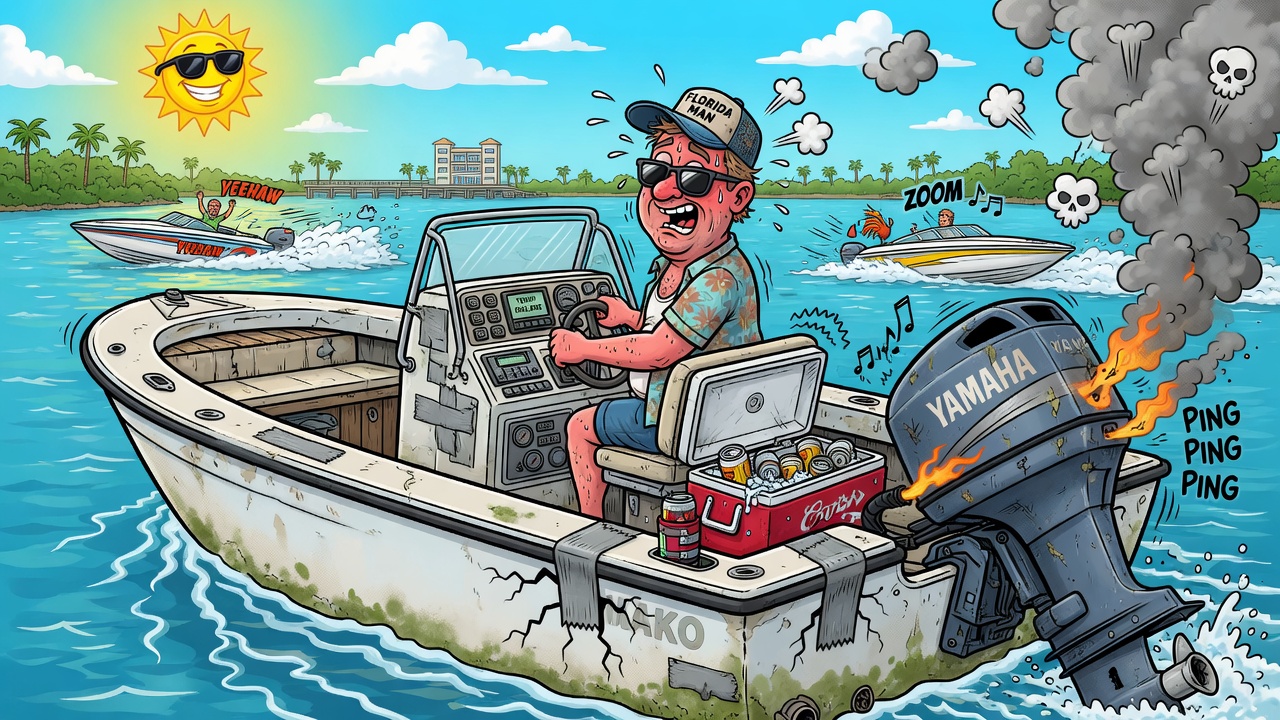
The boat was an old Mako center console — twenty years old, maybe more, nobody's exactly sure. The motor was a Yamaha OX66 250, roughly the same vintage. Ugly, loud, loved. John's whole attitude toward the whole setup was: as long as the key turns, it runs, and it floats, we're OK. He just wanted the thing to go.
Looking back, we were probably pushing our luck. There was a crack in the transom. In a boat that age in Florida, that usually means rot underneath. The bilge pump ran every five or ten minutes like clockwork — that little whir you'd hear, kick on, kick off, all day long. John treated it like background music. I treated it like a boat that was slowly changing its mind about floating. But the motor was still bolted on, we were still flying to Peanut Island, so we called the whole thing fine.
Things are different now. John's sober — life stuff, legal stuff, the whole reset. He's not doing the beer run or the old Peanut Island program anymore. The girls are probably still out there. John just wants the water now. The run. His ramp. The feeling of leaving the dock on a Saturday. Same boat. Different reasons.
When it started going wrong
It happened on a normal trip. Same ramp, same cooler full of beer, same plan.
The motor overheated. We shut it down and floated in the ICW for thirty or forty minutes while it cooled down. We ate our Publix subs — Pub Subs, because of course that's what you eat when your boat quits on you — while other boats blasted past and rocked us in their wake. Sitting there eating a turkey sub while everyone else flies by is a specific kind of Florida humiliation.
We limped home. The engine never felt right after that.
John tried again the next week. Made Peanut Island. But it ran rough the whole time and lost power on the way back. We got home, because somehow we always did. Still, you could tell something inside that old OX66 was giving up.
Ten years for the ramp, then click
This is the part that still gets me.
John had been on a waiting list for his Lighthouse Drive ramp for ten years. Ten. Other people were launching every weekend while he kept hearing "not yet." Then he finally got it. Paperwork cleared. His ramp. After a decade.
A few weeks later he went down to start the boat.
Turned the key.
Click.
That's it. Not a rough idle. Not sputtering. Just one clean click and nothing. Totally out of nowhere. John figured batteries — that would make sense, right? Dead battery, jump it, move on.
Nope. Batteries were fine. The motor had frozen solid inside. The key worked. The engine didn't.
The boat just sat there on his brand-new ramp looking perfectly fine, because boats always look fine. That's what they do.
What we found when John opened it up
John started tearing into it himself. He's done this before. One time he pulled the lower unit off and got so frustrated he threw half his tools over the fence. I respect it. We've all been there. His version was just more literal.
When the heads came off, the story got clear fast:
- Stuck piston
- Water in the heads
- Bad heads
- One cylinder rusted up badly
That's not a weekend fix. That's a full powerhead rebuild on a twenty-year-old two-stroke that's already lived a hard life in saltwater.
What Pete said
We took it to Pete. John's friend, boat mechanic, and the kind of guy who will tell you the truth even when you don't want to hear it.
On the motor, he didn't hesitate:
Don't rebuild it. Buy a used, newer four-stroke. Bolt it on. Go boating.
On the transom:
That motor can fall off at any minute.
He wasn't trying to be funny. The transom is cracked and probably rotten, and there's a 250-horsepower motor hanging off it. Pete's point was simple: don't throw money at an old OX66 when the back of the boat might not be trustworthy either.
John loves that Mako. Always has. But he doesn't need that motor specifically. He needs the boat to go again. Out his ramp, across the water, toward Peanut Island — not for beers, not for the old pastime, just for the run and the sun and proof that Saturdays still work.
Where we're at
The OX66 is done. Heads are off. Rebuild is off the table, at least according to Pete, and Pete's usually right about this stuff.
The Mako is still there — old, cracked transom, still floating, still John's. His ramp is paid for and waiting. Right now it's basically a very expensive parking spot for a dead motor.
The plan, if we can swing it: find a used newer four-stroke, fix the transom before something falls into the ICW, and get John back on the water.
He waited ten years for that ramp. Got it. Turned the key. Heard a click. Found out the batteries weren't the problem, the motor was. Found out the transom's been laughing at us for years. Found out Pete thinks rebuilding the OX66 would be throwing good money at a bad situation.
Bad luck? Yeah. Kind of absurd, honestly. But John's not giving up on the boat. He just wants it to go again.
Key turns. Motor runs. Boat floats. That's all he ever really wanted.
Right now we're one for three. The floating part's been doing all the work.
If you've been through something like this — old boat, dead motor, mechanic friend telling you the truth — drop us a line.